
Intelligent Equipment
The intelligent equipment industry is currently in a golden development period driven by both policy support and market demand. "Intelligence, greenness, and integration" have become the core development directions. At the policy level, it is clear to promote the upgrading of key industries and major technological equipment research and development. From workshop automation transformation to the construction of full process digital factories, the market continues to demand digital and integrated solutions for intelligent equipment. In this context, building a collaborative and digital efficient control system has become a key path for intelligent equipment enterprises to enhance their core competitiveness and achieve sustainable development.
Management Challenges
Equipment manufacturing is a typical technology intensive industry that involves advanced technologies from multiple disciplines and fields, with complex product structures, numerous components, and high process requirements. The production process covers multiple links such as research and development, procurement, production, and assembly, requiring close collaboration across departments. Any problem in any link may affect the entire production schedule and product quality. Therefore, enterprises have strict requirements for product quality and high requirements for traceability.
- Long production cycle, multiple nodes, heavy workload of cross departmental assistance, and difficult delivery management
- Difficulty in controlling work in progress, low material homogeneity, and low on-time production rate
- The production organization of different products is difficult, and there are significant differences in processes and procedures. Production management is affected by complex situations, making it difficult to control in real-time and accurately
- The production process is long and there are many quality control points, which hinders the discovery of abnormalities and makes it difficult to issue quality warnings
- Inaccurate collection of production data makes it difficult to calculate manufacturing costs, quality costs, personnel performance, and salary
- Extensive equipment management, lagging operation and maintenance, lack of preventive maintenance and knowledge base
- The collection and feedback of information on the production site are lagging behind, and insufficient data restricts the efficiency of production management decision-making
- Multi variety, small batch production, with a large number of semi-finished products and purchased parts, high requirements for inventory accuracy, and high requirements for collaborative production processes
Solution
Based on the characteristics of the equipment manufacturing industry and barcode based application management, we have developed a solution for digital control of all aspects of production, including production planning, material distribution, production management, assembly station management, data collection, equipment maintenance management, and visual management. We have built a product lifecycle data chain to solve the problems of process fragmentation, data silos, and traceability. At the same time, a multi-level quality control system of "prevention interception improvement" is constructed based on ISO/national military standards and other standards, comprehensively improving the quality, efficiency, and cost control capabilities of enterprises.
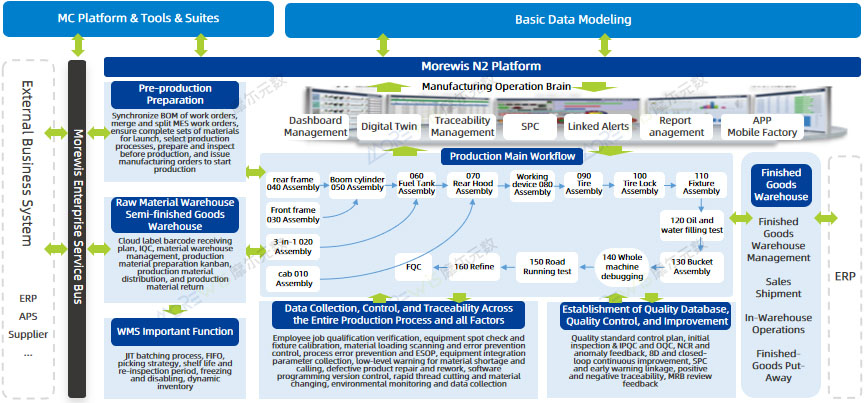
Digital Solution Blueprint for Intelligent Equipment
Addressing Core Needs
- Based on the overall assembly plan scheme, achieve full process collaborative optimization from online monitoring, process scheduling to resource scheduling
- Realize precise supply of materials in the assembly workshop through demand driven feeding and JIT material distribution mode
- Intelligent production process control ensures precise feeding and error prevention, automatic verification and traceability of process stations, and automated warning systems
- Real time collection and cloud synchronization of key data on the production site to ensure traceable data throughout the entire process from raw material warehousing to finished product outbound
- Real time collection of production progress through the system, accurate statistics of working hours, and rapid response to anomalies, with transparent management of personnel
- By identifying key material combinations at the assembly station, real-time monitoring of material matching and assembly processes is achieved, achieving full chain quality control from material admission, process execution to finished product inspection
- For exceptional release scenarios at assembly stations, digital identification tracking, automatic verification of process paths, and error prevention and control mechanisms are used to ensure traceability of replenishment tasks and closed-loop closure of nodes
- Collect data during the production execution and debugging processes to provide comprehensive data support for production optimization and fault tracing
- Preventive maintenance, upkeep, and spare parts management of equipment to improve equipment utilization
- Integrate key process data such as production and operation, quality, and equipment, establish a real-time data flow and visual monitoring system, and promote collaborative operations between departments
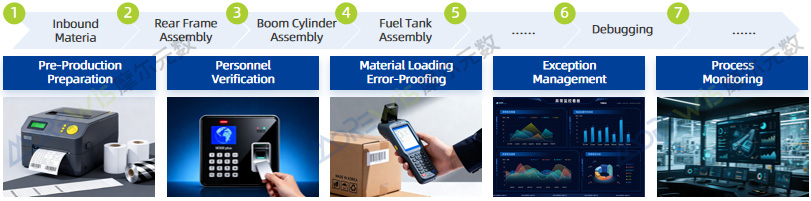
Key data collection at the production site
Implementation Benefits
- Dynamically track key parameters and equipment operating status, promptly alert for abnormalities, and respond quickly to prevent risks
- Accurately control procurement, inventory, and distribution, automatically generate demand lists based on production plans, and achieve on-time supply of materials
- Real time quality inspection and data collection, automatic comparison of standard data, timely detection and correction of deviations
- Comprehensively record production factor data, accurately trace quality issues, and shorten traceability feedback from one day to one minute
- Monitor equipment status and fault information, predict risks and arrange maintenance in advance to achieve zero unplanned downtime
- Unified scheduling plan and real-time data sharing, comprehensive collaborative work efficiency, and improved operational efficiency
- Collaborate with external partners to share production plans and demand forecasts in real-time, driving efficient synchronization of the supply chain
