
Aerospace & Defense
In recent years, with adjustments to China's national defense strategy and the rapid advancement of information technologies, the aerospace and defense industry has entered an unprecedented stage of development. This growth places new demands on the operational efficiency of defense enterprises. Digital transformation has already become a critical force enabling the industry to manage uncertainty, mitigate risks, reduce costs, and improve quality and efficiency. As a result, more research institutes and defense enterprises are building internal digital assets, leveraging system applications to reshape their organizations, workflows, and overall operational capability.

Management Challenges
The aerospace and defense industry is a typical small-batch, multi-variety discrete manufacturing sector. It is characterized by a high volume of R&D-oriented products, extensive product diversification, and exceptionally complex production processes. As a result, manufacturing workflows require a high degree of flexibility, along with full-process traceability for products.
- The large number of product models, combined with overlapping R&D and mass-production activities, makes it difficult to control the frequency and quantity of material distribution.
- Complex plan changes require capacity estimation and scheduling based heavily on manual experience, resulting in significant gaps between planned and actual outcomes.
- High process requirements but insufficient real-time control over critical process steps make it difficult to track production details in a timely manner.
- Stringent product quality requirements demand rigorous quality control throughout the manufacturing process.
- Limited production transparency results in poor visibility into production status, machining progress, and quality information, making production history difficult to trace.
- Some of the CNC machines still operate in standalone mode, and workshop management relies on personnel experience.
- The large volume and complexity of production-related information make data integration challenging.
- Workshop information is massive and complicated; human-driven information transfer is slow, error-prone, and results in significant information loss.
Solution
Based on the challenges above, Morewis helps aerospace and defense enterprises build a digital intelligent manufacturing and operations platform. Through the interconnection and interoperability of digital R&D and design, transparent production sites, and high-quality products, the platform enables multi-dimensional management across key business scenarios—including resource modeling and management, material management, process management, planning and scheduling, task dispatching, work execution, data collection, process control, quality traceability, dashboard monitoring, statistical analysis, and access control. This strengthens refined control over critical processes and key operations, significantly improving internal collaboration efficiency as well as production process stability and product quality.
In addition, the solution offers strong configurability, scalability, and integrability, enabling different enterprises to implement their unique process workflows and management requirements directly through on-site configuration. Given the industry's heightened focus on data security, the solution supports system operation control, user access rights, three-role management, classification-level management, and password policies. It has also passed compatibility certifications with major domestic vendors—including Kylin, NFS-China, Dameng, and Kunpeng—meeting the requirements for domestic software deployment and providing robust support for localized implementation in aerospace and defense enterprises.
Addressing Core Needs
- Digitally model personnel, equipment, materials, structures, and resource groups through object-based modeling to enable unified management and maintenance of all physical resources on the production shop floor.
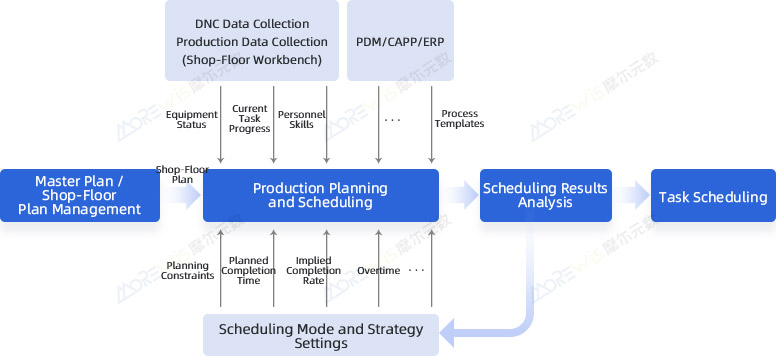
- Dynamically calculate capacity loads and consider constraints, enabling visualized intelligent scheduling through Gantt charts.
- Adopt a structured process-design approach to refine resource granularity. By unifying and flexibly invoking processes, operations, equipment, and tooling, the system enhances the enterprise's process capability.
- Implement barcode-based material control in the workshop and integrate with third-party systems, smart racks, and smart storage to improve material handling efficiency.
- Establish forward and backward traceability across all tracking units, including orders, work-in-progress batches, material and raw-material batches, multi-level packaging numbers, and individual product serial numbers.
- Build equipment and tooling ledgers to track equipment status throughout the entire process, provide timely feedback, and notify relevant personnel for maintenance through early-warning functions.
- Conduct quality inspections and quality tracking for raw materials, production, and testing stages to achieve comprehensive product quality traceability.
- Collect, analyze, and feed back production information in real time through multiple methods, and visually present the entire production environment—including processes, manufacturing stages, materials, quality, and equipment—in a centralized view.
Advanced Planning and Scheduling (APS)
Implementation Benefits
- Build digital models of all key production entities to enable unified management of shop-floor resources.
- Enable automated scheduling through advanced planning, improving the convenience and agility of plan dispatching.
- Generate electronic tracking cards for scheduled tasks to provide real-time execution feedback and ensure production transparency.
- Integrate enterprise design and process workflows to enhance internal collaboration and improve production efficiency.
- Standardize the quality-management process to strengthen product-quality control and elevate overall product quality.
- Perform statistical analysis of production data and enable deep traceability of production history to optimize production stages and enhance overall manufacturing performance.
