
Photovoltaics / Semiconductors
As one of the key sectors in the green energy industry, the photovoltaic industry has achieved rapid growth in recent years under the "dual-carbon" goals. However, the fluctuating prices of silicon-based raw materials have resulted in persistently high operating costs for photovoltaic manufacturers. Reducing costs and increasing efficiency has thus become an inevitable path for the industry's development. For photovoltaic enterprises, it is essential not only to optimize the energy efficiency of equipment but also to reduce costs in non-hardware operations. As a result, digital transformation and intelligent upgrading have become critical drivers for the industry. These will help enhance production efficiency, improve product quality, strengthen market competitiveness, and achieve sustainable development throughout the entire lifecycle.

Management Challenges
The photovoltaic industry is structured around silicon and spans 23 links across the upstream, midstream, and downstream segments, including polysilicon, silicon wafers, cells, modules, and power plants. It integrates both process-based operations (such as material feeding and crystal pulling) and discrete manufacturing processes (such as machining silicon rods and assembling PV modules), making it a typical hybrid industry. The manufacturing process of photovoltaic products is complex, involving many production steps and stringent quality requirements. As a result, enterprises face many management challenges in production:
- Production plans can not be easily formulated accurately and cannot respond to market demands in a timely manner
- Variations in polysilicon purity across batches and unstable cell-processing quality
- Numerous procedures and complex processes in silicon wafer and cell production, making production tracking difficult
- High dependence on equipment, resulting in stringent requirements for equipment maintenance, repair, consumables, and data control
- Difficulties in data collection and analysis during production, with feedback not being timely
- High rework rates in furnace loading, squaring, and wafer inspection; frequent errors in crystal pulling and ingot batching, making loss statistics difficult
Solution
The Morewis digital solution for the PV industry serves the entire production process of PV products — from automatic loading to packing and off-line — covering manufacturing scenarios such as PV wafer production, cell manufacturing and module production. By collecting, controlling and tracing the key 4M1E factors (Man, Machine, Material, Method, Environment) involved in production processes, it enables accurate planning, efficient process management and lean quality control. At the same time, process parameters are automatically collected through equipment interfaces; combined with the structured data analysis tools provided by the system, production issues are resolved quickly, processes are continuously optimized and product quality is improved — helping PV companies achieve rapid mass production and maximum capacity.On top of the existing digital foundation, the solution further adds an “AI capability layer”, forming a dual-engine architecture of “digital foundation + AI capability layer”. It builds a closed loop of perception — cognition — decision — execution, deeply integrating AI into the entire PV / semiconductor manufacturing process.
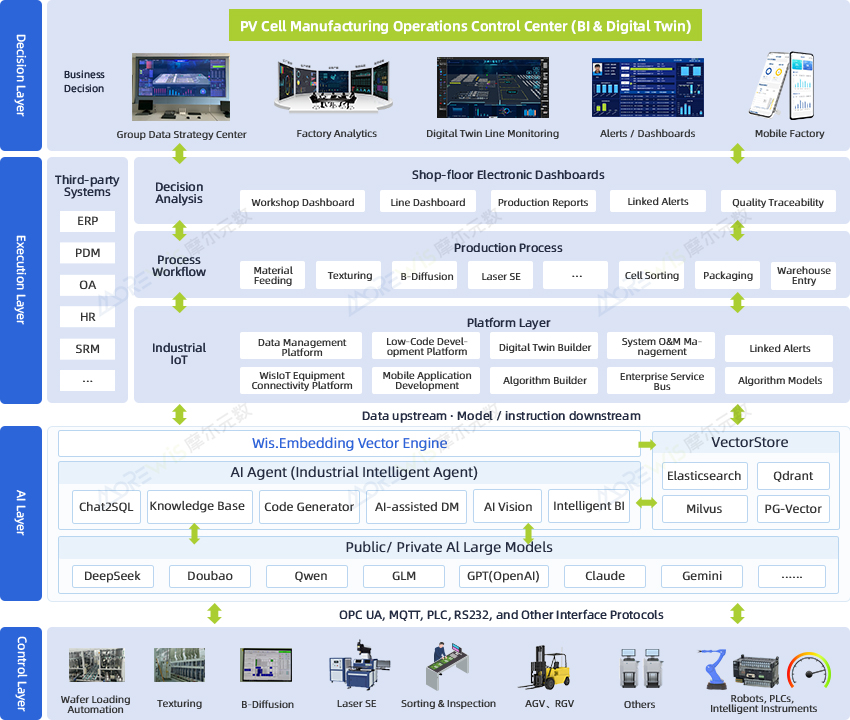
Blueprint for Planning and Building a Digital Factory for PV Cell Manufacturing
Addressing Core Needs
- Barcoding across the entire warehousing workflow, with mobile operations and material control to enforce FIFO. AI combines demand forecasting with an inventory-age model to anticipate stock levels and alert on slow-moving or overdue items; machine vision verifies inbound and outbound goods and coordinates AGVs and the AS/RS for line-side kit delivery, improving warehouse efficiency.
- Visual drag-and-drop scheduling with intelligent plan adjustment, linked to workshops and production lines. AI applies operations-research optimization for multi-constraint scheduling and reinforcement learning to handle silicon-material price swings and rush orders; digital twins simulate process routes, plans are tracked in real time, and WIP orders are managed with full transparency. For key processes, data is captured and completion is reported automatically by the system; AI calculates labor hours and capacity takt in real time, and SPC anomaly detection automatically identifies takt deviations and dispatches work orders, making production progress visible in real time.
- Fine-grained traceability built at cassette and wafer ID level. AI links IDs with 4M1E data through a knowledge graph to build a material genealogy chain, enabling second-level traceability from loading to packaging, one-click generation of factory-audit and recall evidence, and precise pinpointing of individual units or batches.
- Full-dimensional TPM covering equipment ledgers, inspections and maintenance. AI draws on equipment time-series data to predict remaining useful life and issue work orders automatically; a vector-retrieval knowledge base powers a fault-diagnosis assistant, with closed-loop traceability across the whole process.
- Full lifecycle management of tooling, fixtures and spare parts. Based on inspection and requisition records, AI predicts remaining life and triggers replacement alerts, calculates safety stock, and reduces both slow-moving inventory and material shortages.
- Quality data from IQC, FAI, IPQC, FQC and OQC is collected and analyzed through multi-dimensional SPC; AI machine vision performs inline inspection of wafer, cell and module defects, and - combined with process baselines - automatically closes the loop on root-cause attribution, supporting multi-level alerts and exception traceability.
- Built on the WisIOT smart IoT system, production-line equipment parameters are automatically collected and monitored in real time. Edge AI detects time-series and process anomalies to deliver trend-based early warnings, while dashboards dynamically present analysis results and root-cause attribution.
- Paired with the WisBI intelligent analytics system, it builds a comprehensive production-transparency management system. Large language models support natural-language queries on capacity, yield and other metrics, while AI automatically locates the root causes of fluctuations and outputs improvement recommendations, improving on-site response efficiency.
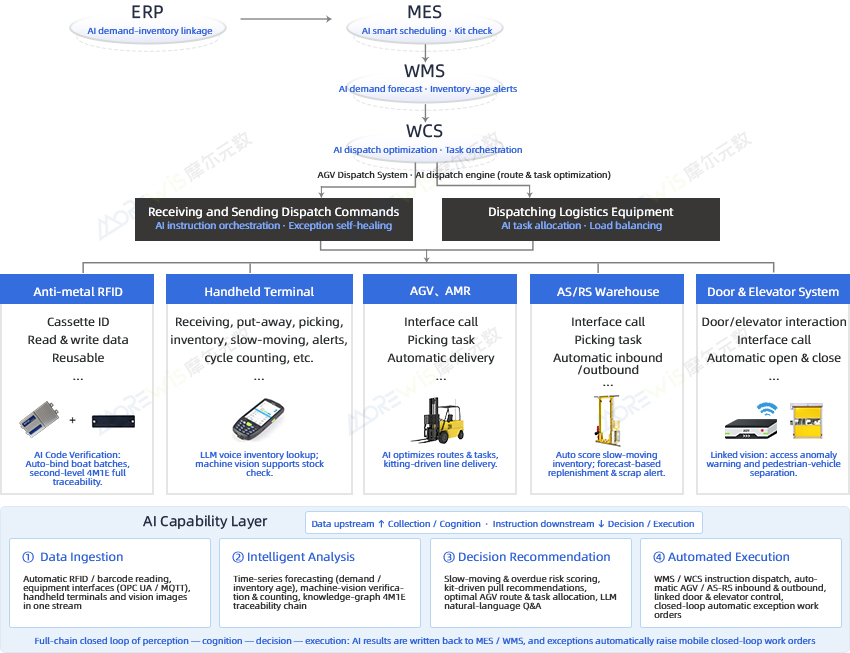
Integration of Warehouse Operations with Intelligent Logistics AGVs and AS/RS Equipment
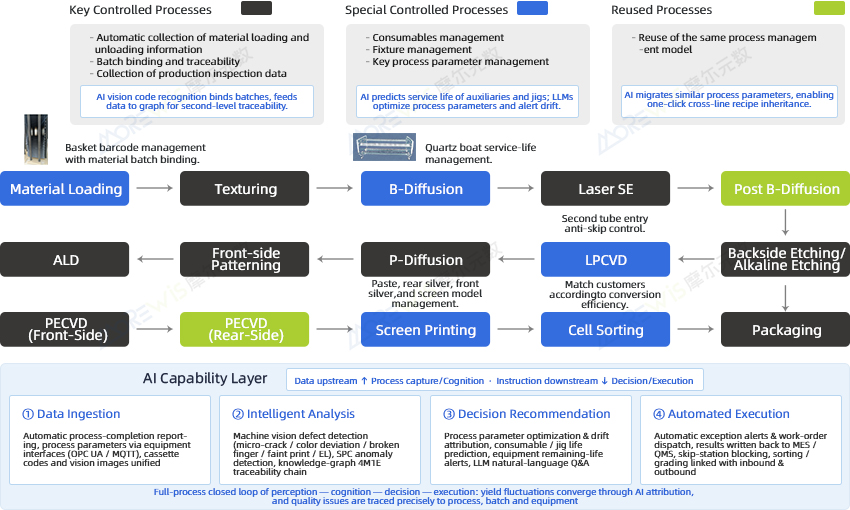
Manufacturing Process Control Points
Implementation Benefits
- Optimize production planning and scheduling, enabling flexible adjustments at workshop and production-line levels, and improving overall line efficiency.
- Connect the traceability data chain to build a full-process traceability platform, ensuring stable and controllable product quality.
- Strengthen process quality control through comprehensive quality management, reducing product defect rates.
- Integrate with equipment to achieve automatic data collection, reduce manual intervention, and lower error rates.
- Enable paperless on-site operations, digitizing and mobilizing equipment, process, production, and facility inspection tasks.
- Visualize production data in real time, providing an accurate view of workshop operations and achieving transparent production.
