
Biopharma
As a national strategic emerging industry, biopharmaceuticals covers segments such as chemical pharmaceuticals, biological products, in vitro diagnostics, and medical devices. It is characterized by strict regulation, high compliance requirements, and zero tolerance for errors, with extremely stringent requirements for whole-process production control, data retention, and batch traceability. Driven by the digital economy, China's biopharmaceutical industry is flourishing. In particular, as oversight by domestic and international drug regulators such as the FDA continues to tighten, GMP standards, electronic batch records, full-process traceability, and compliance audits have become hard market-entry requirements, compelling enterprises to achieve compliant production, controllable batches, and fully traceable production operations through digitalization.
Management Challenges
Compared with other industries, the biopharmaceutical industry strictly follows GMP compliance and batch traceability management requirements, with an extremely low quality error tolerance. The traditional production management model has many compliance shortcomings and cannot meet drug regulatory inspection standards, constraining enterprises' compliance clearance and production efficiency. The industry faces the following management challenges:
- Stringent compliance control with demanding GMP requirements across the whole process; heavy workloads for change, deviation, and traceability management
- A wide variety of materials with shelf-life sensitivity, complex batch management, and great difficulty in mix-up prevention and first-in-first-out control
- Highly sensitive process parameters; variations in manual operation can easily trigger batch quality fluctuation
- Production is mostly small-batch and high-mix, with frequent line changeovers, insufficient scheduling flexibility, and low equipment utilization
- Lagging real-time collection of equipment operating data, with stringent requirements for the real-time performance of equipment alerts and status monitoring
- Fragmented cross-departmental information; production, quality, and laboratory data are not interconnected, anomaly response lags, and it is difficult to build closed-loop compliance control
Solution
The Morewis digital solution for biopharmaceuticals focuses on core scenarios such as GMP implementation, electronic batch records, full-process compliance traceability, and closed-loop quality control. Addressing the industry's compliance pain points, it builds a digital factory system adapted to drug regulatory inspections, helping enterprises achieve compliant production, higher quality, and greater efficiency. The solution strictly conforms to GMP standards and UID compliance requirements, solidifying production processes, operating standards, and compliance systems into standardized system workflows, and building a digital management system that integrates production execution, batch record management, quality traceability, equipment control, and document compliance. It manages and monitors the production process in real time, provides error-proofing and tracking of materials and processes throughout, and automatically collects, monitors, and raises alerts for production equipment. This makes it easier for managers to grasp production data dynamics and accurately understand quality conditions at each stage, thereby enhancing GMP compliance management capability and product quality stability.
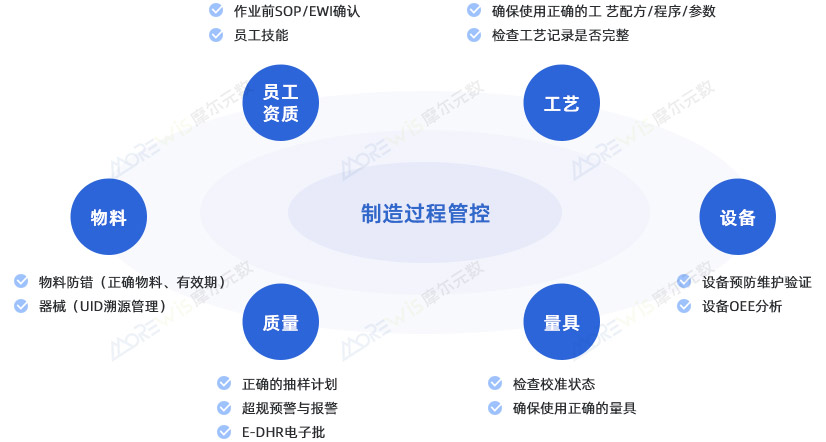
Building a Digital Factory for the Biopharmaceutical Industry from the Manufacturing Process
Materials Added: Pharmaceuticals (GMP Traceability Management)
Addressing Core Needs
- Establish a production error-proofing and full-process traceability system that fully meets GMP and UID compliance requirements and strengthens the enterprise's compliance capability
- Automatically collect production process data and archive it to generate electronic batch records (E-DHR), meeting compliance requirements for precise traceability and rapid inspection
- Integrated management of planning and scheduling, material kitting, and planned manufacturing, reducing production waiting waste caused by plan adjustments
- Transparent and refined management of the production process, standardizing work procedure standards and avoiding manual operation deviations
- Collect and manage in-process product quality data through barcode scanning at each level, achieving forward and reverse 4M1E compliance traceability
- Build closed-loop quality management across the IQC, PQC, FQC, and QA chain, achieving full-process control of quality alerts and anomaly handling
- Implement TPM equipment management through the system, enabling interconnection of key production and inspection equipment and supporting visual feedback on equipment monitoring, alerts, status, and OEE
- Break down departmental data silos, drive refined management with data, and improve overall compliance and collaborative control capability
- Systematically manage warehousing and materials, solidify incoming inspection processes, standardize batch, shelf-life, and first-in-first-out management, and complete full-chain GMP compliance traceability of materials
- Adapt to medical compliance regulations by building a standardized process approval and electronic signature system to meet industry document compliance control requirements
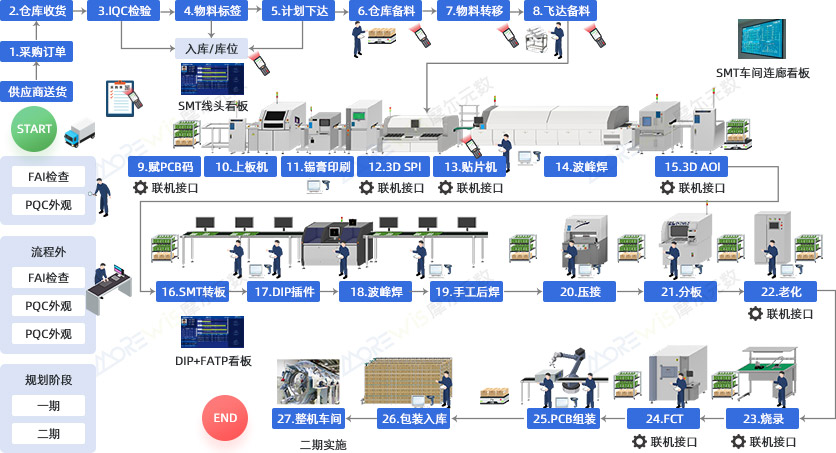
Example - Overview of Full Business Value Stream Control for the Medical Device Industry (“SMT + FATP”)
Application Benefits
- Establish a standardized production error-proofing and full-process control mechanism, consolidate the GMP compliance system, and reduce audit risks
- Fully automatic collection of data across the whole production process and digitized batch records, achieving compliant traceability
- Break down data barriers between production, quality, materials, and equipment, making the entire production process visible, controllable, and traceable
- Closed-loop quality control across the whole process, stabilizing product quality consistency
- Digital equipment control to ensure compliant, stable, and efficient operation of production equipment
- Data-driven management, providing precise data support for compliance upgrading, quality improvement, and capacity optimization
