
Injection Molding & Stamping
With the rapid growth of China's national economy, demand for daily-use products has significantly increased. In industries such as automotive, construction, home appliances, food, and pharmaceuticals, the need for injection-molded products continues to rise, driving explosive growth across the injection molding sector. The industry is characterized by high-mix, low-volume production, with diverse product specifications and complex process flows, where production capacity directly affects delivery performance. As raw material and labor costs continue to rise, enterprise profit margins are shrinking. At the same time, global manufacturing division of labor is becoming increasingly prominent, and outsourcing by major brands is now widespread. Customers have raised their expectations for suppliers' on-site management capabilities. As a result, implementing digital systems such as MOM/MES to support lean production has become an inevitable choice for many enterprises.
Management Challenges
Currently, the level of digitalization and intelligentization in China's injection molding industry remains relatively low. Many injection molding enterprises still rely on ERP and MRP systems for production planning and material requirements, while production operations remain stuck in a management model characterized by low efficiency, high consumption, and suboptimal quality levels. As a result, numerous issues arise throughout the production process:
- Injection molding materials have short procurement cycles, and delivery schedules for molded products are under significant pressure.
- There is a wide variety of injection molding machine brands and models, making molding parameters difficult to control.
- Material usage lacks clarity, gate scrap management is missing, and material types are complex.
- Collaboration is difficult, with many factors to consider and limited access to timely information.
- Product variety is high and processes are complex, making quality control challenging.
- Shop-floor management is complicated, real-time tracking is difficult, and alarms rely on manual monitoring, resulting in slow response times.
- Equipment utilization is difficult to improve effectively.
- Mold management requires strict control, while mold maintenance remains difficult to monitor and manage.
- Production reports cannot be delivered to managers in real time.
Solution
The Morewis digital solution for the injection molding industry is a dedicated platform designed to support production and manufacturing management for injection molding enterprises. It addresses key requirements such as injection molding machine connectivity, work order dispatching and reporting, SOP and drawing release, mold issuance, and quality inspection. Through barcodes, injection molding machine data collectors, and other data acquisition methods, the system captures real-time information from the shop floor—including machine status, mold status, work-in-progress, materials, orders, and quality data. It builds a comprehensive manufacturing information database and provides a unified platform for manufacturing execution control and production quality management. By supporting full process traceability and control, the solution helps enterprises achieve transparent, lean, and digitalized production management.
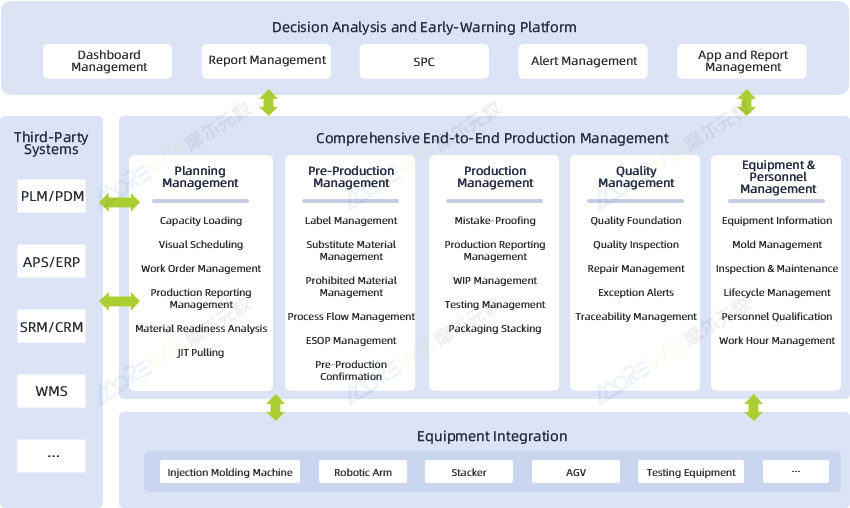
Overall Business Blueprint for the Injection Molding Digital Solution
Addressing Core Needs
- Enable intelligent connectivity of production equipment, eliminating equipment and information silos. The system provides maintenance and upkeep plans, automatically generates reports, visualizes equipment status monitoring, and offers automatic maintenance reminders as well as performance evaluation.
- Automatically record mold inbound and outbound activities, track mold lifecycle usage, and log maintenance records. Through maintenance inspections, lifecycle management, and efficiency-improving shelving processes, the system supports refined mold management.
- Collect information from equipment, tools, products, personnel, and customers to generate coordinated plans for production, warehousing, mold workshops, equipment management, and other departments, assisting in production planning and scheduling.
- View real-time production status for each machine across workshops, monitor real-time material consumption, track live work order progress, and receive production exception alerts through the system.
- Record actual molding parameters in real time—including machine cycle, labor cycle, temperature, and pressure—to ensure full traceability of product quality and mold-adjustment history, providing a solid basis for building flexible, multi-mode production processes.
- Ensure that only personnel with the required qualifications operate at critical positions, while the system proactively prevents and blocks equipment or tooling with potential risks from entering production.
- Implement systematic quality management across the entire injection molding process, ensuring all inspection information is fully traceable and establishing a closed-loop mechanism for handling quality defects to enable proactive prevention and rapid response.
- Using diversified data acquisition methods, the system compares actual process parameters with standard indicators to establish a comprehensive traceability framework that meets both customer audit requirements and enterprise management needs.
- Through 3D factory simulation and modeling, the system provides visualized real-time status, statistics, and KPI information for each manufacturing department, enabling real-time monitoring, sharing, and feedback to support multidimensional, efficient, and collaborative decision-making.
- Automatically, timely, and accurately generate various reports and drive notifications via shop-floor dashboards, SMS, and email reminders. This enables full process transparency, seamless coordination across all nodes, clear accountability, timely information delivery, and efficient task handling.
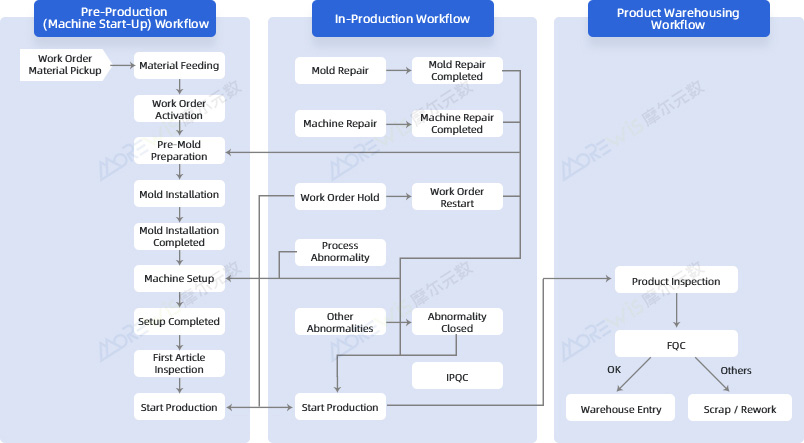
Injection Molding Production Process Overview
Implementation Benefits
- Strengthen process tracking and control to improve on-time delivery performance and shorten delivery cycles.
- Standardize the management of molds, injection molding machines, and other equipment to increase machine utilization and overall production efficiency.
- Enhance control over process and quality parameters to improve product quality.
- Increase shop-floor transparency and ensure full production traceability, enabling effective quality improvement and cost control.
- Integrate all enterprise information systems to enhance data sharing and improve cross-departmental collaboration efficiency.
