
Fuyao Group
Fuyao Glass Industry Group Co., Ltd. is a large multinational enterprise specializing in automotive safety glass and is listed on both the A-share and H-share markets. The company provides global OEM support services and complete automotive glass solutions, ranking among the top players in global market share. Fuyao has established production bases in 16 provinces and cities in China and in 11 countries and regions worldwide. Its products have been certified and adopted by globally renowned automotive manufacturers, including Bentley, Mercedes-Benz, BMW, Audi, General Motors, Toyota, Volkswagen, Ford, and Chrysler.

Business Needs
- In-warehouse operations rely on offline manual activities without system control, creating risks that cannot be monitored or predicted.
- Complex and diverse business processes easily lead to unclear accounting and time-consuming production statistics.
- The original transit-warehouse system was not connected with upstream and downstream systems, resulting in isolated data that could not be shared.
- Fixed-asset ledgers and related information were recorded manually on paper, making traceability and management impossible.
Implementation Overview
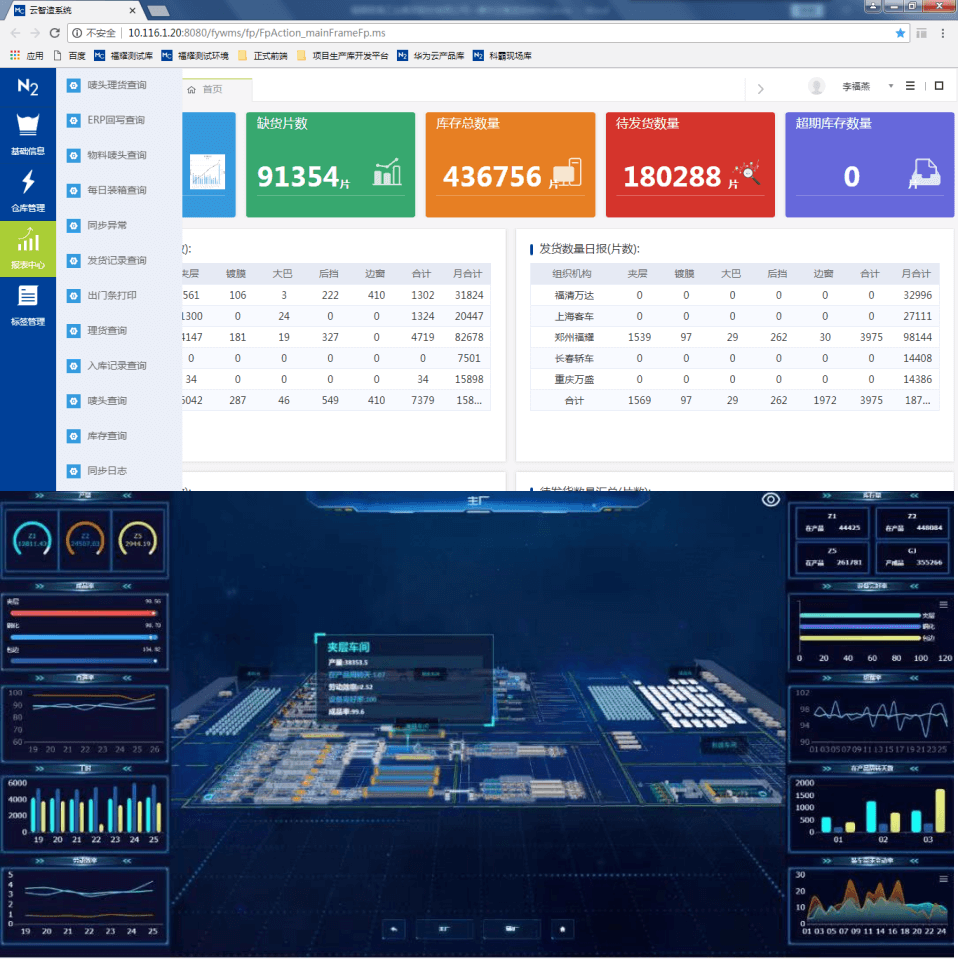
N2.WMS Warehouse Management System, WisBI Intelligent Analytics System, Wis3D Digital Twin System
Covers material management, warehouse modeling, factory calendar, label management, Kanban management, warehouse management, strategy configuration, sorting list management, and traceability reports. The system supports warehouse operations in Changchun, Zhengzhou, Fuqing, Shanghai, Guangzhou, Foshan, Liuzhou, Chongqing, and other locations.
How the Solution Addresses Core User Needs
- Implements a task-based execution model through the system to control in-warehouse operations such as packing, relocation, and shipping, making warehouse business processes more standardized.
- Establishes a pull model centered on customer delivery; mobile applications connect manufacturing plants with transit warehouses, enabling production material kitting, real-time work order tracking, and adjustment.
- Integrates upstream and downstream systems to achieve data interconnection and sharing, with real-time reporting to support managerial decision-making.
- Establishes a digitalized warehouse and logistics management model, enabling real-time visualization of transit warehouse status and digital management of fixed-asset information.
Implementation Benefits
- Shipping accuracy rate reached 100%
- Average material search efficiency increased by 80%
- Inventory counting efficiency increased by 70%
- FIFO execution rate increased to 96%
