
Electronics Assembly
With the rapid advancement of electronic technologies, electronic products have become widely used across all areas of production and daily life, and consumer expectations continue to rise. For electronics assembly enterprises, fast-changing market demand has led to a production model characterized by high mix and low volume. Under frequent product changeovers, companies must organize production efficiently, continuously increase capacity, and reduce costs. As a result, adopting smart manufacturing to enhance market competitiveness has become an inevitable trend.
Management Challenges
Today, in addition to mainstream SMT assembly, the electronics assembly industry has adopted more advanced technologies such as reverse-sequence assembly and 3D assembly technology. These innovations are pushing the industry toward finer precision, micro-assembly, printed circuitry, and greener products, placing higher demands on enterprise production capabilities.
- Small-batch, high-mix production coexists with large-scale manufacturing, while frequent plan changes and urgent insert orders make scheduling more complex.
- The variety and quantity of materials make management difficult. Manufacturers and distributors often apply different barcodes, resulting in low material-search efficiency, higher error rates, and difficulties in traceability.
- PCBA production involves numerous process control points and relies heavily on manual management, resulting in high quality risks and difficulty in traceability.
- Real-time production equipment data cannot be captured or utilized effectively to support management.
- There are many production consumables and tooling fixtures, yet systematic and effective control measures are lacking.
- The production process lacks transparency; progress at each operation cannot be monitored in real time, making delivery cycles difficult to manage.
- Gaps in the production traceability chain lead to insufficient control over key processes and critical materials.
- Test data from ATE, aging tests, and functional tests of finished units are manually recorded or manually judged, making quality-issue traceability difficult.
Solution
To meet the specific production characteristics of the electronics assembly industry, the Morewis Digital Solution for Electronics Assembly—built on the MorewisCloud platform and deployed as a suite package—enables enterprises to enhance management across R&D, production, and after-sales, thereby improving operational efficiency. The solution provides core functions such as warehouse management, production planning, process engineering, production management, quality management, equipment management, alert management, and KPI-based decision analytics. It unveils the "black box" of shop-floor information management and helps enterprises address challenges in production control, quality traceability, and enterprise-level system integration, ensuring the achievement of cost, quality, and delivery targets.
This solution is suitable for single factories as well as multi-factory or group-level enterprises. It has been widely adopted in various sectors—including automotive electronics, communications electronics, new-energy electronics, medical electronics, power electronics, defense electronics, and machinery equipment—empowering enterprises to strengthen core smart-manufacturing capabilities and enhance market competitiveness.
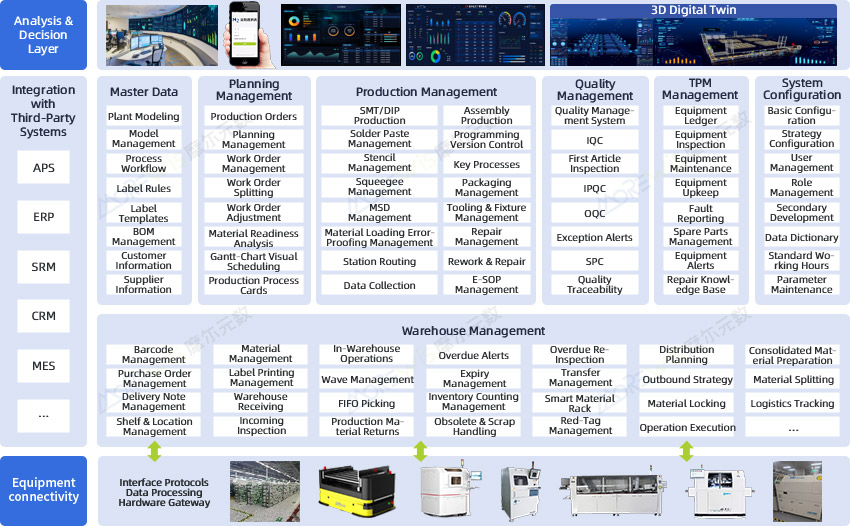
Overall Digital Functional Architecture for the Electronics Assembly Industry
Addressing Core Needs
- Integrate with work-order plans to enable visualized scheduling, allowing work orders to be split or merged and production modes and processes to be flexibly selected based on batch size.
- Apply barcodes, PDAs, and related technologies to track all warehouse operations and implement digital, controlled warehouse management.
- Support multiple material-distribution modes, including smart light-guided racks, workstation-based distribution, and kitting-based distribution.
- Utilize a 5M1E error-proofing system to provide timely feedback, tracking, and handling of production abnormalities, enabling systematic mistake-proofing.
- Link products with their process routes to ensure full process management in accordance with the defined routes, and analyze key parameters to support real-time production control.
- Provide dynamic quality-analysis methods to analyze key production parameters in real time, issue immediate quality alerts, and support closed-loop management.
- Use barcode-based unified management to record and track production-process information, enabling real-time visibility into production progress and achieving complete bidirectional traceability across materials, quality, and other production stages.
- Integrate with various types of equipment to collect status and test data online, enabling monitoring of equipment conditions and energy efficiency.
- Deploy production-line, shop-floor, and material dashboards to visualize, display, and manage data related to production, materials, and quality.
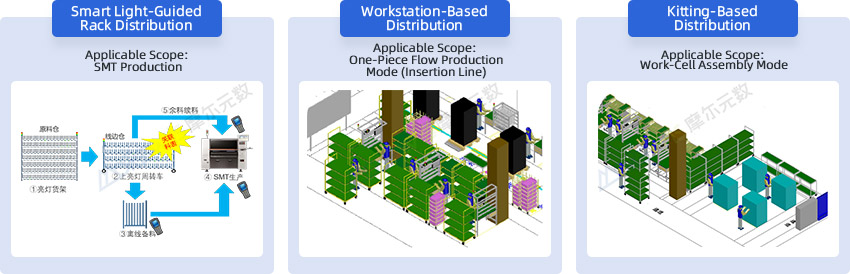
DevelopingDistribution Methods That Support Flexible Production Models
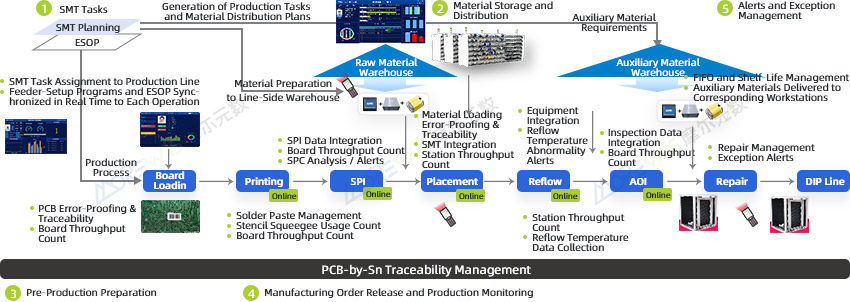
SMT Production Management Improvement Plan
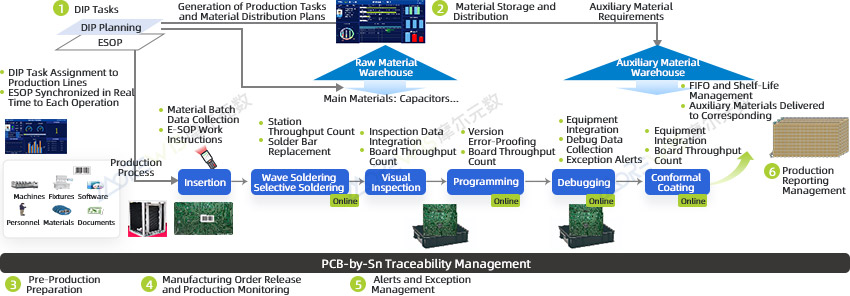
DIP Production Management Improvement Plan

Data Visualization Applications
Implementation Benefits
- Enable full transparency of the production process, improving on-site management efficiency and reducing management complexity.
- Support flexible configuration of production processes to enable planning and scheduling with rapid coordination between production and materials
- Enhance process control, material control, and quality control to improve real-time responsiveness to abnormalities.
- Improve material flow efficiency and provide comprehensive product tracking and traceability.
- Support multiple production modes, including manual assembly lines, automated assembly lines, and work-cell operations.
- Establish digital connectivity among equipment, materials, personnel, and systems, enhancing visibility of the factory and production processes.
