
Warehousing & Logistics
In today's fully digital and intelligent era, the manufacturing sector is undergoing rapid transformation driven by changes in the business environment, evolving business models, and the adoption of emerging technologies. To achieve transformation and upgrading, more and more enterprises are embracing continuous innovation. As a critical component of the manufacturing supply chain, warehousing not only serves as a fundamental means for achieving lean warehouse operations but also plays an indispensable role in enabling intelligent manufacturing and aligning with Industry 4.0.

Management Challenges
Factory warehousing involves multiple tightly connected stages—including procurement, receiving, inventory counting, material preparation, and material issuing. Any error or delay in one stage may lead to low efficiency, high costs, and difficulties in quality control, making it impossible to meet the needs of diversified production and digitalized management. The main challenges include:
- Material origins and destinations cannot be traced, and traceability becomes even more difficult when personnel change.
- Operations recorded on paper or spreadsheets result in low efficiency and high error rates in material searching, preparation, and storage.
- FIFO is managed using color tags or even memory-based issuing, leading to poor FIFO compliance.
- Significant discrepancies exist between book inventory and actual stock, affecting purchasing plans and production material usage.
- Incoming and outgoing materials are prone to missed inspections, non-standard execution, and mis-issuing incidents.
- Slow-moving, expired, returned, and unused loose materials are common, resulting in frequent cost losses.
- Warehouse operations lack transparency, and delayed KPI reporting creates challenges for management decision-making.
Solution
Morewis warehousing and logistics solution focuses on optimizing warehouse execution and enhancing operational efficiency. Through integrated software–hardware tools that enable seamless information exchange between suppliers and customers—combined with barcode-based operations—the solution connects the entire manufacturing warehousing flow, from order receipt and work-order release to material preparation, issuance, production, and final shipment. It effectively addresses the complexities of material management and warehouse operations, helping enterprises transition from manual and mechanized warehousing to automated and intelligent systems. This accelerates material flow, reduces production costs, safeguards production schedules, and strengthens resource control.
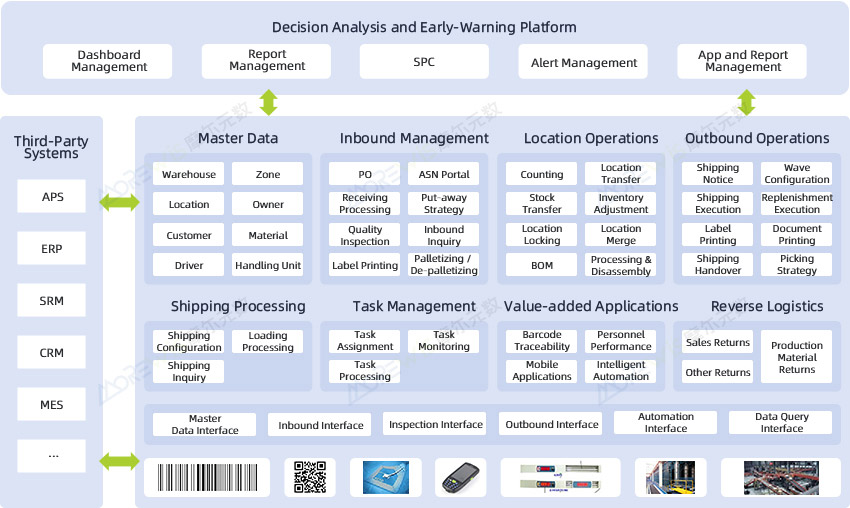
Business Blueprint for the Warehouse and Logistics Solution
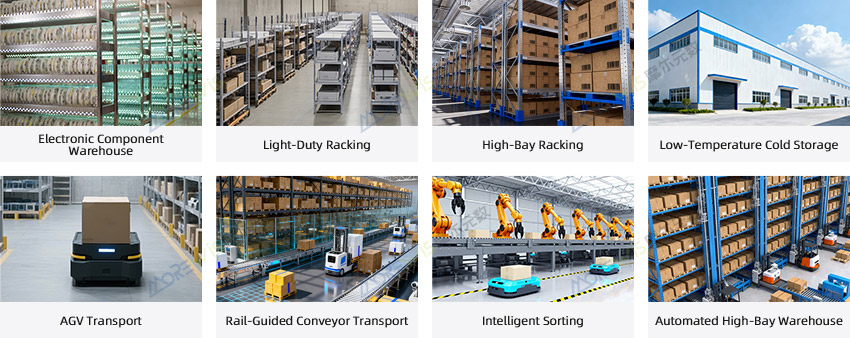
Diverse Industry Application Scenarios
Addressing Core Needs
- Use barcode-based material identification and error-proofing to reduce mis-issuance losses and improve picking accuracy and efficiency.
- Enable suppliers to print inbound barcodes via the cloud and verify material documents, improving receiving efficiency and preventing incorrect receipts.
- Support multiple inventory-counting methods with intelligent gain/loss calculation, automatically identifying stock discrepancies and ensuring inventory accuracy.
- Provide system-guided picking routes with kit-completeness prioritization to secure material availability for urgent orders and improve issuing efficiency.
- Support diversified JIT-driven material picking models to meet the material delivery needs of different industries and production modes.
- Enable flexible definition of exception categories and system-based tracking of slow-moving materials to prevent costs caused by abnormalities and stagnant inventory.
- Achieve precise full-lifecycle material traceability, ensuring every movement is trackable.
- Automatically generate and visualize warehouse-management KPIs to support informed decision-making.
- Support the creation of visualized 3D warehouse-simulation models to enable real-time information transmission, analysis, and sharing.
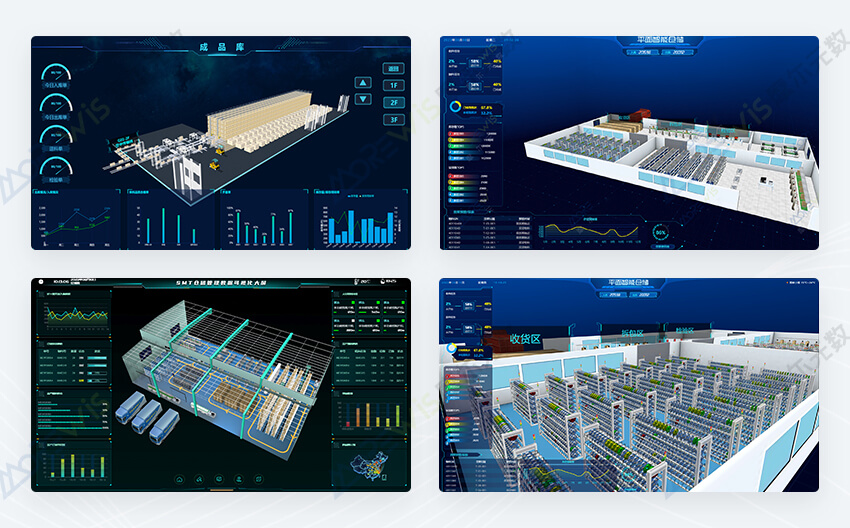
3D Digital Twin-Based Full-Scope Warehouse Simulation
Implementation Benefits
- Ensure timely data collection and precise process control from picking and processing to outbound delivery, enabling intelligent automation and improving operational efficiency.
- Implement precise bin-location management and comprehensive status monitoring to increase warehouse utilization.
- System-controlled FIFO with automated bin allocation for put-away and picking reduces human errors and significantly improves warehouse turnover efficiency.
- Enable efficient inventory counting and high warehouse transparency to maintain and control enterprise inventory levels effectively.
- Ensure end-to-end linkage across logistics processes, enabling rapid traceability to production stages and improving product quality.
- Build a fully visualized, traceable, paperless, barcode-enabled, and digitalized intelligent warehouse.
