
Optical Comm.
Against the backdrop of rapid expansion in AI computing power and digital infrastructure, the optical communications industry has entered a period of high-speed growth. As computing-network convergence advances in depth, optical networks are breaking through their traditional positioning as information transmission channels and gradually evolving into a key component of the computing infrastructure, with the fusion of optical technology and intelligence becoming the industry's core innovation theme. The upstream and downstream of China's optical communications industry chain are accelerating domestic substitution and capacity expansion, and demand for digital and intelligent transformation across the industry continues to climb, becoming a long-term development trend. Meanwhile, empowered by 10G optical network pilots and ongoing computing-network convergence policies, full-process traceability capability and digital management systems are gradually becoming key thresholds for market access.

Management Challenges
The optical communications industry chain covers core segments including optical chips, optical components, optical devices, optical modules, and optical fibers and cables. It involves both process-type manufacturing (preform deposition, fiber drawing) and discrete-type manufacturing (optical module mounting, coupling and packaging, testing and packing), making it a typical hybrid manufacturing industry, where the production process faces many management challenges:
- Optical module coupling requires sub-micron precision (±0.1 μm); manual operation is subject to physiological limits, and frequent changeovers across many product types cause yield fluctuation and low efficiency
- Core materials carry high unit prices and require unit-/lot-level traceability; data gaps exist across the entire chain, making it difficult to meet customer audit and regulatory compliance requirements
- Production and inspection equipment of all kinds use inconsistent protocols, making data exchange difficult; equipment status is disconnected from production planning, and the utilization rate of high-end equipment is low
- Die bonding, wire bonding, coupling, packaging, and testing — more than ten process steps in total — involve complex process parameters, making the production process hard to trace
- Unplanned downtime of key equipment causes huge losses, placing extremely high demands on equipment maintenance, repair, inspection, and data control
Solution
The Morewis AI digital solution for the optical communication industry serves the entire production process of optical communication products — from optical chip packaging to finished optical module testing and packing — covering manufacturing scenarios such as optical device manufacturing, optical module assembly and testing, and optical fiber & cable production. Built on the dual engines of a digital foundation plus an AI capability layer, the solution establishes a closed loop of perception — cognition — decision — execution. By managing and tracing the key 4M1E factors (Man, Machine, Material, Method, Environment) across production processes, it enables accurate planning, efficient process management, and lean quality control. In addition, key process parameters such as coupling precision, optical power, and eye diagrams are automatically collected through equipment interfaces; combined with the structured data analysis tools provided by the system, production issues can be quickly identified and resolved, processes continuously optimized, and product yield improved — helping optical communication manufacturers achieve rapid ramp-up and maximum capacity.
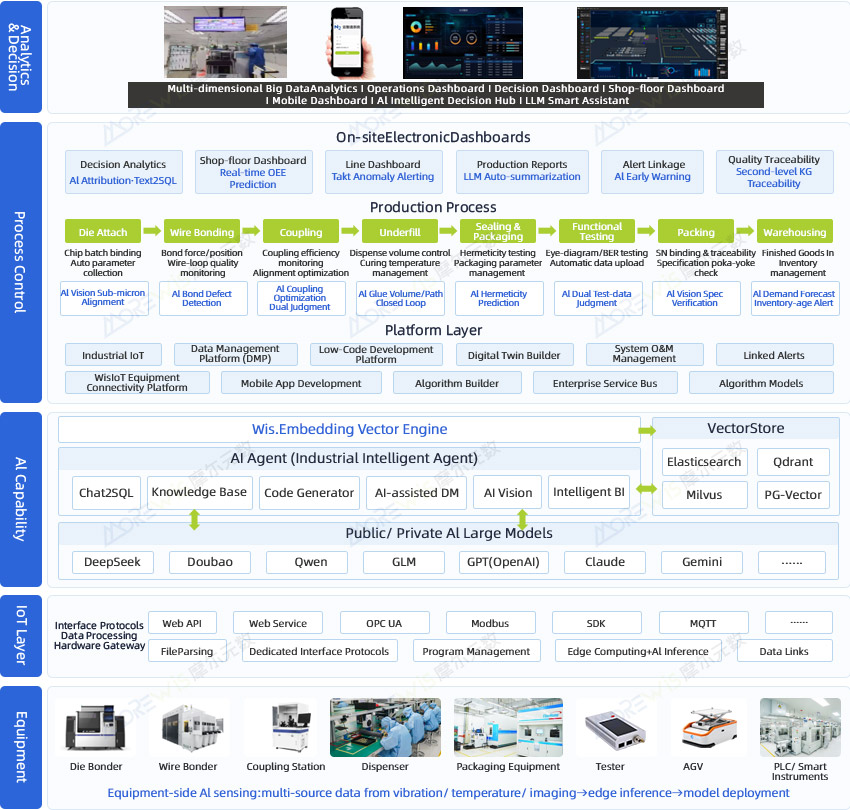
Blueprint of the Optical Communications Industry Solution
Key process parameters are automatically collected through equipment interfaces; combined with structured data analysis tools, production issues are quickly located and resolved, processes continuously optimized, and product yield improved — helping optical communication enterprises achieve rapid mass production and maximum capacity. With AI, this closed loop advances from after-the-fact analysis to real-time prediction and autonomous optimization.
Addressing Core Needs
- Barcode-based mobile operations with strict FIFO execution and slow-moving / overdue stock alerts; an AI inventory-age model outputs risk scores and coordinates with AGVs / automated warehouses for work-order-driven material delivery
- Visual drag-and-drop scheduling and intelligent plan adjustment support rapid changeovers in multi-product optical module mixed-line production; AI performs rolling scheduling using operations research optimization + reinforcement learning, with changeover plans validated in a digital twin
- Automatic data collection and reporting at key processes deliver real-time takt-time statistics and transparent progress; an AI edge gateway + time-series models compute takt times, while SPC + AI identify deviations
- Serial-number-level, full-process 4M1E traceability for optical chips and modules meets factory audit and product recall requirements; an AI knowledge graph enables second-level forward / reverse tracing, and large models automatically generate factory audit reports
- Automatic judgment of ±0.1 μm coupling precision with automatic OTDR / spectral data synchronization; AI machine vision + sub-micron measurement provide dual rule-based + model-based judgment
- Fine-grained management of equipment ledgers, plans, inspections, and maintenance; operating data such as vibration and temperature enables predictive maintenance, with AI anomaly detection and RUL remaining-life prediction plus LLM-assisted diagnosis
- Full lifecycle management of coupling fixtures, test jigs, and spare parts; AI predicts remaining jig life and prompts replacement, while ML spare-parts forecasting optimizes safety stock
- IQC / IPQC / FQC / OQC full-process data collection with multi-dimensional SPC analysis, multi-level alerting, and closed-loop exception handling; AI adds anomaly detection and YOLO-based appearance inspection
- Automatic collection and real-time monitoring of key production / inspection equipment parameters, dynamically displayed and analyzed on electronic dashboards; AI edge MQTT collection with threshold- + AI-based automatic alerting
- Builds a comprehensive production transparency management system and improves real-time on-site responsiveness; AI integrates the data warehouse, BI, and LLM Q&A (Text2SQL + RAG)
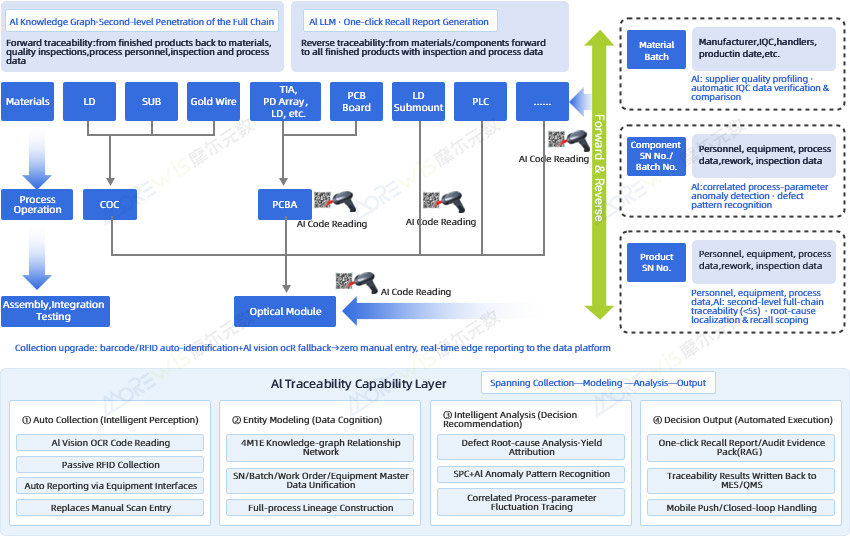
Full-Process Forward and Reverse Traceability - Example - Optical Module
Application Benefits
- Support rapid changeover for mixed production of multiple optical module types, enable flexible plan adjustment at the workshop and line levels, and improve overall line production efficiency
- Establish a full-process traceability platform from optical chips to finished optical modules, meeting the factory audit and product recall requirements of domestic and international customers
- Strengthen quality control capabilities in key processes such as coupling and testing, reducing the product defect rate and improving coupling yield
- Automatic collection of key parameters such as coupling accuracy, optical power, and eye diagram, reducing manual intervention and the error rate
- Electronic and mobile inspection of equipment, processes, production, and facilities
- Reflect workshop production conditions in real time, enable data-driven decision-making, and achieve transparent workshop production
- Reduce unplanned downtime of key equipment and improve overall equipment effectiveness (OEE)
